
Functional Freeze, Back to School, and Why Transitions Ask More of Your Nervous System Than You Think
September has a way of asking a lot of us all at once. New routines, new schedules, new demands on everyone in the house, sometimes overnight. The urgency is REAL! And somewhere in the middle of the school supply lists, seasons changing, and the calendar getting full again, a lot of people quietly go missing from their own lives.
Not in a dramatic way. Not a breakdown. More like a slow fade. You're still doing everything. You're still showing up, still functioning, still getting through the list. You just aren't really there for any of it.
That's functional freeze. And if you've been feeling foggy, flat, or like you're watching your week happen from a few feet outside your body, I want you to know what might actually be going on underneath it.
Functional freeze isn't the freeze you're picturing
When most people hear the word freeze, they picture something still or stuck, like a deer in headlights. Frozen mid sentence. Unable to move.
But there's another version of freeze, one your nervous system can hold for weeks at a time while you keep the whole operation running. Lunches get packed. Emails get answered. You show up to the school meeting, nod in the right places, drive home, and can't remember a single thing that was said.
Your body is in a low tone freeze state. It's downregulated, conserving energy, running the bare minimum of what's needed to get through the day. It isn't broken, and it isn't bad, it's just also not fully online. It's protecting you the only way it currently knows how, by partially checking out while still keeping the lights on.
Why transitions specifically bring this on
Your nervous system runs on predictability. It's constantly asking, underneath conscious thought, a version of the same question: is this familiar, and is it safe, and can I predict what comes next based on what I know.
A transition, by definition, interrupts the familiar. New routines. New schedules. New social terrain for your kids, which becomes new emotional terrain for you. Even good changes ask your body to re-orient, to recalibrate what safe looks like all over again. That recalibration takes energy your system may not have had to spare after a summer of its own chaos.
So your body does what bodies do under sustained, low grade demand. It starts predicting overwhelm before it's even arrived, and it downshifts to conserve what it can. That downshift is functional freeze. It's not a personal failure or a lack of discipline, even though we love to assign it as a personality trait. It's a nervous system trying to survive a season that's asking more of it than it currently has capacity to give.
What this can actually look like
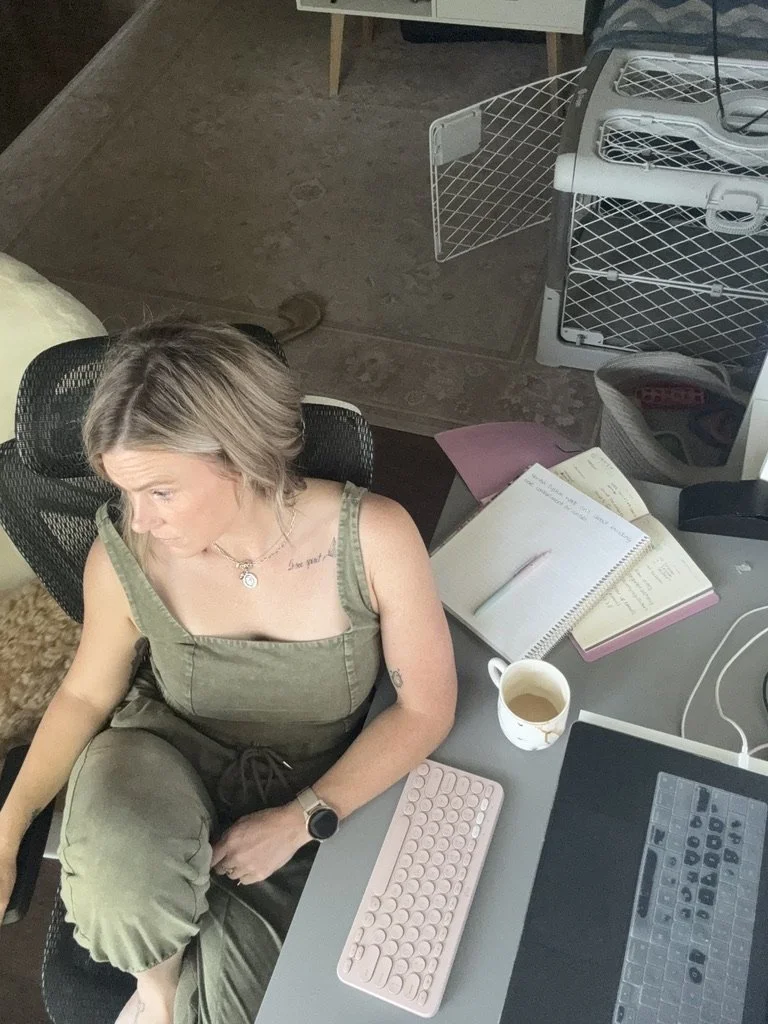
Functional freeze rarely announces itself. More often it shows up as flat affect and running on autopilot, even during moments that would normally feel meaningful. Scrolling for hours. Ordering in even when you wanted to cook and have all the groceries. Living in the waiting room of life, waiting for the thing to happen so you can be happy. Forgetting what someone said mid conversation, or losing entire chunks of your day to a fog you can't quite name.
Everything feeling like a task to check off rather than a life you're inside of.
Crying in the car, then walking in the door like nothing happened.
If any of that is landing, you're not alone in it, and you're not doing anything wrong.
This is a nervous system pattern, not a character flaw
I say this often with clients: you can be fully aware of a pattern, be able to explain it in detail, and still feel completely unable to change it. That's not a willpower problem. Insight lives in the thinking brain. Freeze lives in the body. You can't think your way out of a body state. You have to help the body find its way back. You have to develop a sense of safety in yourself to touch the freeze, and slow down and come back to the connected part of us.
What actually helps, and what doesn't
Advice like just relax or take a break tends to bounce right off a frozen nervous system, because it's talking to the wrong part of you. What often helps is smaller and more physical than that.
Orienting. Let your eyes slowly scan the room you're in. Notice colour, shape, temperature. Notice what turns the corners of your lips up into a slight smile. This tells your nervous system, in a language it actually understands, that it's allowed to come back into the present moment, that it's safe enough to be here. Allowing your system to focus on slow micro movements.
Feeling your weight land. Feet on the floor, body in the chair. Small, boring, and incredibly effective.
Sound. Humming, singing, even a long exhale. This directly tones the vagus nerve, which plays a central role in shifting you out of shutdown.
Borrowed regulation. Time with a person, or a pet, whose nervous system is steadier than yours right now. Regulation is contagious, in the best way.
This is also exactly the kind of work I do with clients, using somatic experiencing, parts work through Internal Family Systems, and clinical hypnosis, all at a pace your nervous system can actually tolerate. Not pushing through. Not white knuckling September or transitions. Helping your body remember it's allowed to come back online and find a sense of safety and self trust.
If this is your season
If you've been reading this thinking, yes, that's me, that's this month, I want you to know this is exactly the kind of thing therapy can help with, and it doesn't require you to have it all figured out before you start.
I'm currently welcoming new clients, both individual and couples. My student therapist, Mich, is also taking on new individual clients. You're welcome to reach out and book with either of us through the link: embodiedwisdom.janeapp.com
This content is for reflection and education only and isn't a substitute for individualized therapeutic support. 💛